Advice to help you live your healthiest life, covering fitness, nutrition, mental health, self-care and much more.
Sep 10, 2026
This blog post was written by third-year Dalhousie medical student Miriam John.
Going to the doctor can be nerve-racking, especially when you’re a little kid. But learning about healthcare procedures with your teddy bear can help transform nerve-racking healthcare experiences into positive ones.
Teddy Bear Clinics are an evidence-based initiative that aims to reduce children’s medical anxiety through imaginative play. At these clinics, we treat stuffed animals like patients, moving through simulated medical stations.
Myself and medical student Sherry Eskander co-founded the Teddy Bear Clinic Initiative at Dalhousie Medicine; fellow medical students Naomi MacMillan, Olivia Mason and myself are the current co-leads of the program.
To date, we’ve hosted clinics for over 300 children and currently have a team of about 30 medical student volunteers. The clinics have been a huge success, helping to ease fear and spark curiosity among children around medical subjects and equipment.
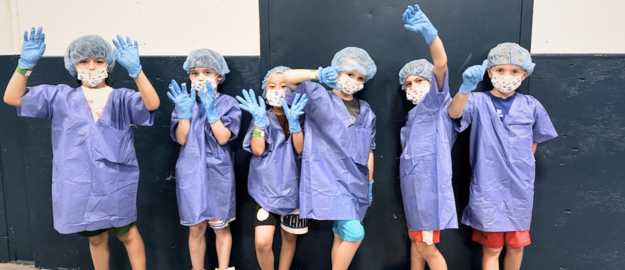
Recently, we had a blast hosting clinics for summer campers from the Boys and Girls Clubs Greater Halifax sites in North and East Dartmouth, Spryfield and Sackville.
Children rotated through six hands-on play-based stations where they learned about getting a check-up, vaccines, IVs, casting, X-rays, going to the operating room and more. Each station included a combination of both child-friendly simulations (for example, Teddy Bear “X-rays” where children figured out what looked different on each X-ray) and real medical equipment (such as stethoscopes and reflex hammers).
The combination helps to familiarize children with healthcare equipment in a safe and fun setting, teaching them what the objects are and what they do. Our vaccination station was especially educational, with simple vaccine education followed by hands-on play where kids could practise giving their teddies and peers “vaccines” with needle-free syringes and vials of water.
Providing children with clear, age-appropriate medical education can help establish trust in the healthcare system and medical interventions from a young age, supporting positive attitudes towards healthcare interactions later in life.
Running Teddy Bear Clinics also has a myriad of benefits for us as medical learners. The clinics provide meaningful opportunities for community outreach advocacy and health promotion. They also help us build positive relationships with the community, and teach us how to communicate with young patients.
We’ve hosted our clinics in a variety of settings, including elementary schools, community partners, shelters and the Ronald McDonald House, allowing us to interact with children from diverse lived experiences, including socioeconomic, cultural and health backgrounds.
This exposure challenges us to adapt our communication style, language and level of detail to meet each child’s individual needs, strengthening our ability to communicate effectively and compassionately with pediatric patients from a range of backgrounds.
A special thank you to all of the incredible student volunteers who make the Teddy Bear Clinics such a special experience! We especially want to recognize Keeley Barnable, who made our Teddy Bear MRI machine.
WANT MORE INFORMATION ON HEALTHY LIVING AND HEALTH-CARE DELIVERY SENT DIRECTLY TO YOUR INBOX? SUBSCRIBE TO OUR NEWSLETTER TO GET ALL OF OUR CONTENT FIRST!