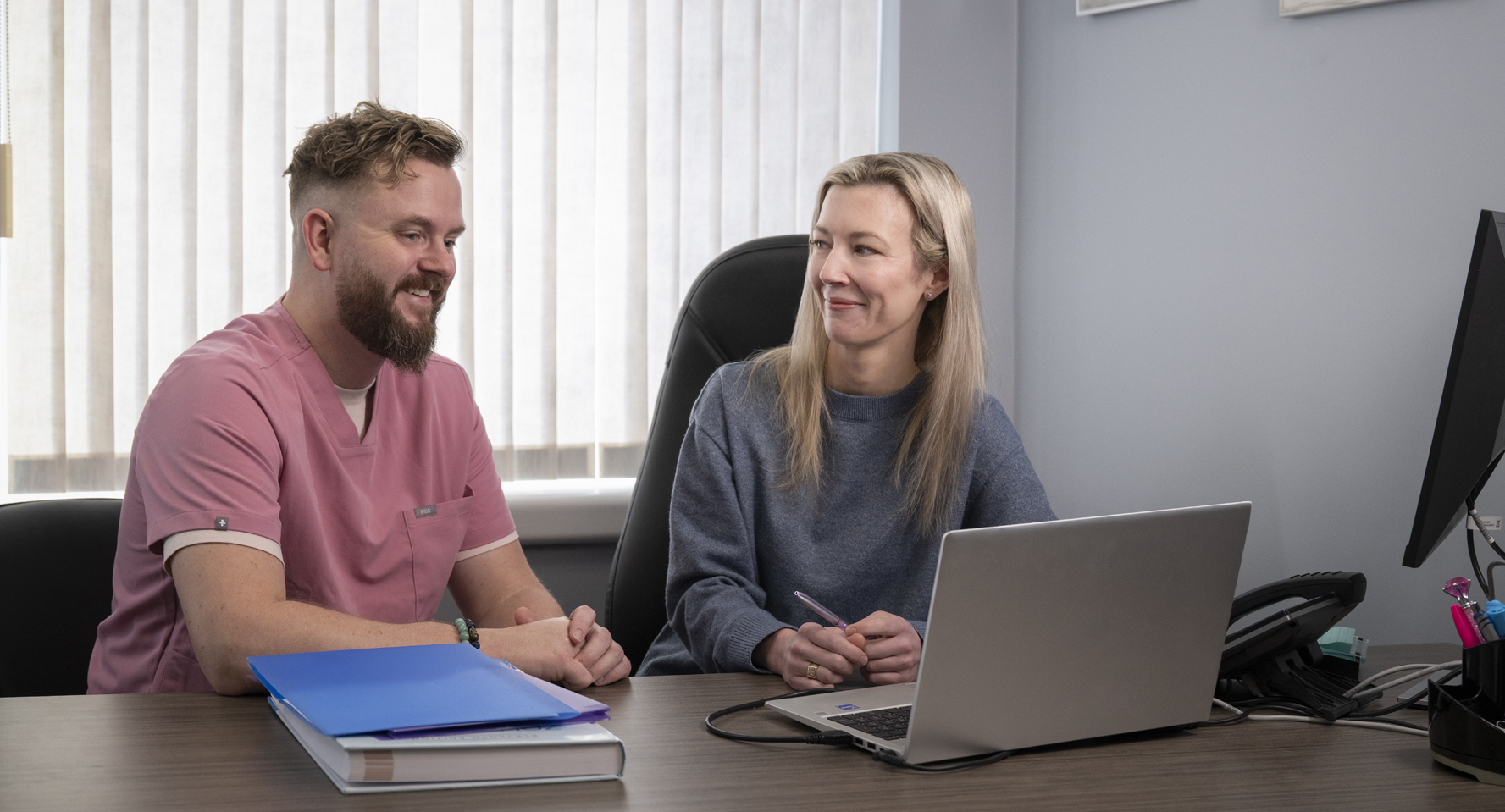
"As specialists, we try to help people who don’t have anybody. We might be the only doctor they are seeing."
Sydney, N.S.
"As specialists, we try to help people who don’t have anybody. We might be the only doctor they are seeing."
Growing up, Heather Poushay always planned to work in healthcare, perhaps as a nurse or a dentist. Being a physician wasn’t on the list.
That changed when she got a summer job as a housekeeper at Cape Breton Regional Hospital in Sydney.
“Being around patients and seeing more of what physicians do and how they can help people get better, made me want to be a physician,” says Dr. Poushay, who is now a general surgeon at the same hospital.
She attended medical school at Dalhousie University and planned to specialize in family or emergency medicine. “But once I had exposure to surgery, I thought, oh my goodness, this is what makes me excited, this is what I want to do.”
“I love being able to fix people with my hands. For me, to be able to see a problem that I can physically change and make better – that is how my brain works. I just love it.”
She completed residency training in general surgery at the University of Toronto, with a goal to eventually return home to Cape Breton.
“I just love the community I grew up in,” she said. “I loved how you knew who people were and you’d see your teachers at the grocery store. I love the safety of it and being able to take a hike in the woods and not have to take a two-hour drive to get there.”
She finished residency, gave birth to her first son and worked in Toronto for a year; by then it was 2020 and the timing was right to move home. She covered a maternity leave at Cape Breton Regional Hospital, then shared a practice for a time before landing a permanent position at the hospital.
She provides a range of surgical care for patients, including hernia repairs, gallbladder and appendix removals, and cancer surgeries (colon and breast cancer are the most common).
“We’re seeing more younger people with cancer now,” said Dr. Poushay. “Thank goodness for screening and being proactive. We’re lucky in Cape Breton that our wait times for colonoscopies are fairly short, so people can get in and get diagnosed.”
Dr. Poushay says she enjoys working in a collaborative, tight-knit group – the surgical team has just seven people. “I know I can call any of them to help, whether it’s for an on-call emergency or to help guide a patient through the system.”
Collaborating with other providers is another benefit of being in a smaller community, she says. “You know everybody – your kids go to the same school or are on the same soccer team. It’s really collegial.”
Helping patients navigate the healthcare system is a huge part of her job, especially for people who don’t have a family doctor and may have undiagnosed health conditions.
Routine blood tests and other screening before surgery can often uncover serious health problems that patients don’t know about, such as type 2 diabetes or a heart condition.
“That’s tough for people because now there’s something else we must address before they can have their hernia repaired or their gallbladder removed,” Dr. Poushay said. “When that happens, I do my best to connect patients either to a primary care clinic or another specialist so they can get the care they need.”
She provides the same guidance for patients when surgery uncovers issues that need follow up. “For example, say somebody comes in with appendicitis and I take out their appendix. On the CT scan, they see an adrenal nodule that will need follow up in six months, but the person doesn’t have a family doctor. Who else is going to see the patient to follow up and order that scan and who will talk about the results or the next step? This happens a lot.”
“As specialists, we try to help people who don’t have anybody. We might be the only doctor they are seeing.”
Dr. Poushay always takes her time with her patients, making sure they understand what’s happening every step of the way. “People have a lot of emotions and worries that can come up at any point,” she said. “I do my best to explain things to them and answer their questions. What is routine to me could be one of the scariest moments of somebody’s life.”
She knows what it’s like to be a patient going through an unsettling experience in the hospital. Dr. Poushay has three young sons, and the middle and youngest were born prematurely, both requiring long stays in the neonatal intensive care unit (NICU).
“The NICU is nothing like general surgery, so it was hard being on the patient side of things and having bumpy roads,” she said. “I realized it’s like that for a lot of my patients. They may have lots of questions but might not know what to ask.”
“My middle son was born at 28 weeks. We were at Sunnybrook Hospital [in Toronto] and it was a terrible experience. My younger son was born even earlier, at 25 weeks. He had a lot more problems, but it was a much better experience for me because of how good the care was at the IWK Health Centre in Halifax.”
These experiences in healthcare have helped fine-tune her approach to providing patient care today. Dr. Poushay knows that surgery can be tricky, with complications arising out of the blue.
She’s always there for patients when things take a turn. “Whether it’s changing my schedule or working things around to get them in. It’s about getting the ones in who need to be seen quicker.”
For her, the key is providing her patients with excellent care and communication, no matter what comes up along the way. “I may not be able to change the outcome, but I can change how people experience it. No matter what they’re going through, I try to make it as easy on them as possible. That’s a really important aspect of providing good patient care.”